

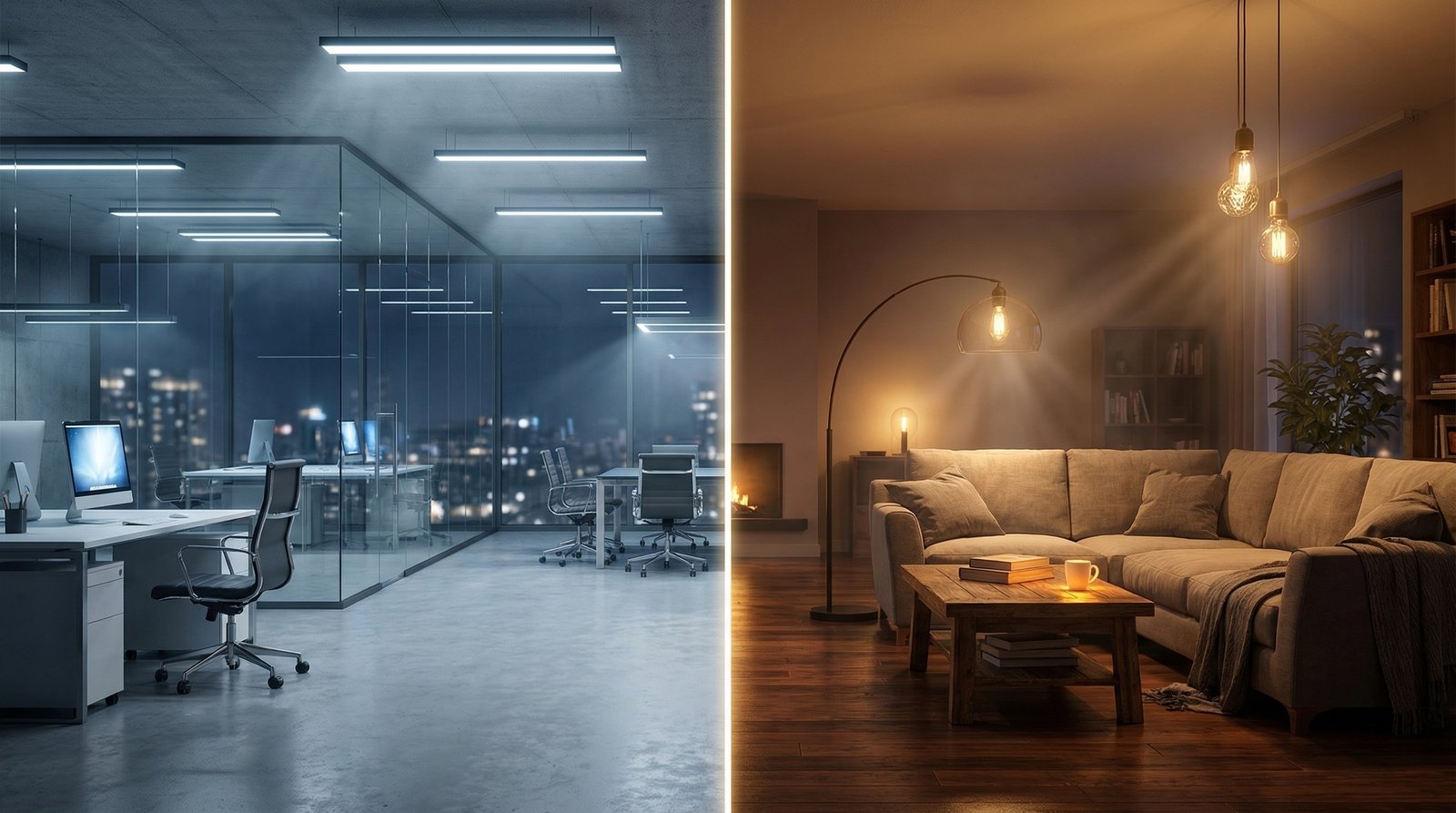

Lighting for a home and lighting for a retail store, office, hotel, or warehouse solve different problems. Using residential-grade bulbs in commercial spaces — or over-specifying commercial fittings for homes — leads to poor performance, unnecessary cost, or early failure. Here is what distinguishes the two categories.
Key Differences at a Glance
| Factor | Residential | Commercial |
|---|---|---|
| Brightness Required | 200–1350 lm per bulb | 1000–5000+ lm per fixture |
| Daily Operating Hours | 4–8 hours | 10–18+ hours |
| CRI Requirement | Ra ≥ 80 (general) | Ra ≥ 80–90 (retail, hospitality) |
| Color Temperature | Warm white (2700–3000K) preferred | Cool white (4000–6500K) often preferred |
| Thermal Priority | Moderate | High — runs for extended continuous periods |
| TCO Importance | Lower | High — saves thousands on energy and maintenance at scale |
| Fixture Base | E27, E14 common | E27, bayonet, or industrial socket depending on application |
Why Commercial Buyers Think in Total Cost of Ownership (TCO)
In a retail chain or hotel with 500 light points, a 1W difference per bulb equals 500W per hour of extra consumption. Over 4,000 operating hours per year, that is 2,000 kWh — equivalent to significant cost in UAE electricity tariffs. Commercial decision-makers calculate energy cost, replacement frequency, and maintenance effort together, not just purchase price.
CRI Matters More in Commercial Spaces
Color Rendering Index (CRI or Ra) measures how accurately a light source reveals the true colors of objects compared to natural sunlight. In retail, poor CRI makes products look dull, reducing purchase appeal. In hospitality, it weakens ambience. For commercial buyers, a CRI of Ra ≥ 80 is a minimum requirement. Ra ≥ 90 is recommended for high-end retail and food service.
Recommended Products by Use Case
- Residential (General): MOBASCH® CLASSIC LED A60 BULB Core Series — 9W–15W, 810–1350 lm, Ra >80, 2-year warranty
- Decorative Residential: MOBASCH® LED CANDLE BULB Decor Series — 8W, 720 lm, 3000K warm white, E14 base
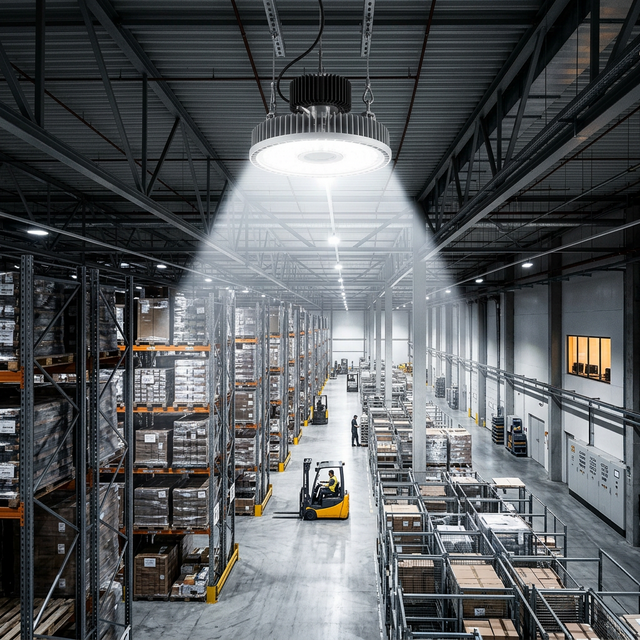
- Commercial / Industrial: MOBASCH® HIGH-POWER LED T BULB — 30–50W, 3000–5000 lm, for warehouses and commercial facilities