


Let's be honest: when your electricity bill in Abu Dhabi or Dubai feels relatively manageable compared to what people pay in Europe or North America, it's easy to shrug and say: "Why bother switching to LED? It won't make a difference." It's a fair question. But the answer might surprise you and your wallet.
The "Cheap Electricity" Myth
Yes, UAE electricity is subsidized, especially for UAE nationals. According to Abu Dhabi Distribution Company (ADDC), UAE nationals pay as low as 6.7 fils per kWh, while expatriates pay 26.8 to 30.5 fils per kWh depending on usage. For context, the average residential electricity price sits around AED 0.29 per kWh - far cheaper than the UK, Germany, or Australia.
So on the surface, cheap electricity seems like a valid reason to be careless. But here's the thing: cheap per unit doesn't mean your total bill is cheap - especially in the UAE, where air conditioners run almost year-round and homes are large.
The Hidden Cost Nobody Talks About
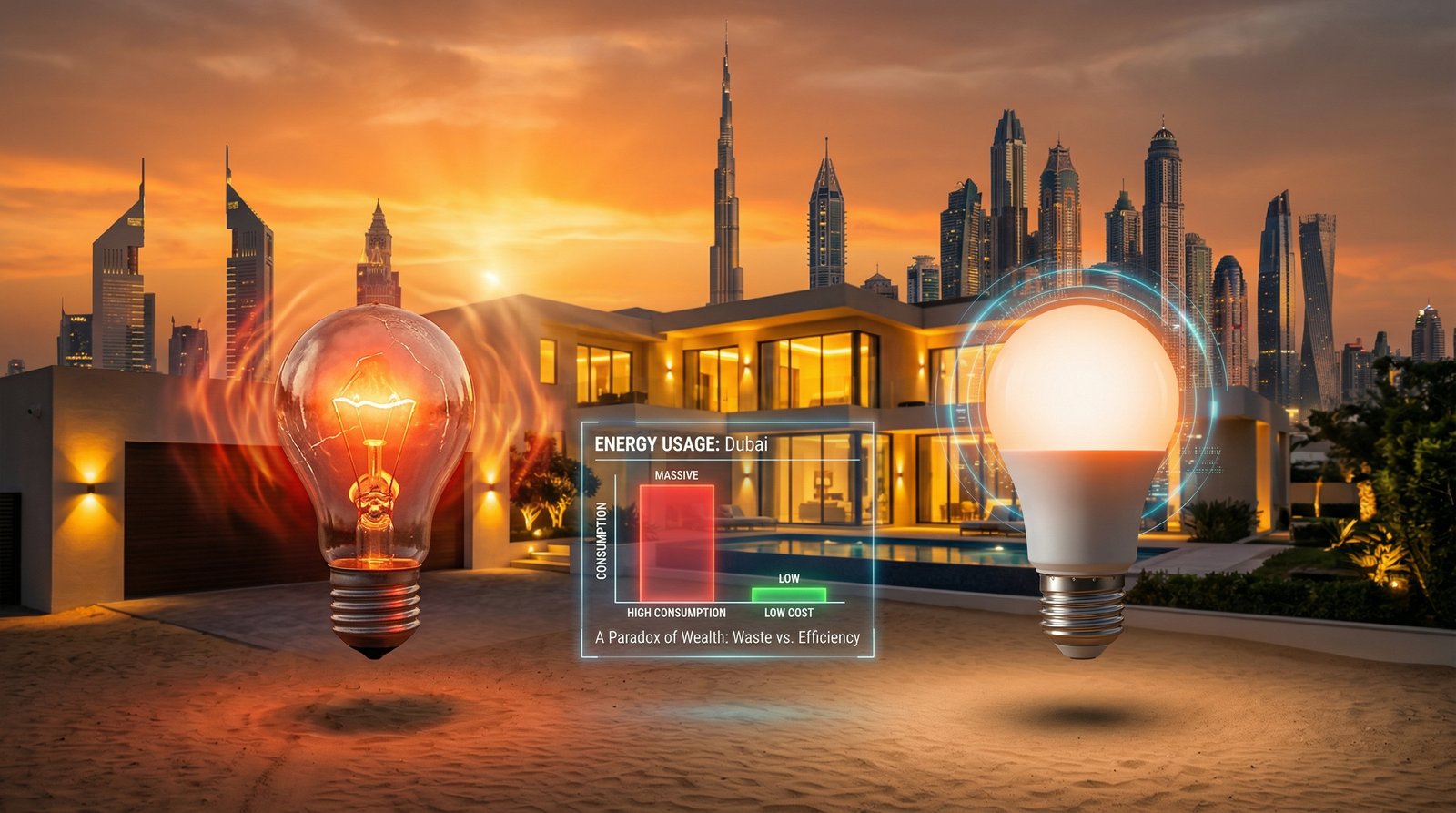
In the UAE, 57% of the country's ecological footprint comes from household energy consumption, and 6% of that is from lighting alone. That might sound small, but consider this: the majority of lighting energy in the UAE still relies on incandescent lamps - accounting for a staggering 78% of lighting energy usage — despite incandescent bulbs being officially banned from sale since the end of 2013.
An incandescent bulb doesn't just waste electricity — it generates heat. In the scorching UAE summers, every watt of heat from a light bulb forces your air conditioner to work harder. So you're not just paying for wasted light - you're paying your AC to undo the damage. It's a double hit on your electricity bill that most residents never calculate.
The Real Numbers: LED vs. Incandescent in UAE
| Feature | Incandescent Bulb | LED Bulb |
|---|---|---|
| Power consumption | 60W | 8–10W |
| Lifespan | ~1,000 hrs | 25,000–50,000 hrs |
| Energy savings | Baseline | Up to 80% less |
| Heat emitted | High | Very low |
| Upfront cost | Low | AED 25–60 |
Switching a whole home to LEDs can cut lighting energy use by more than 70%. According to the UAE's Sustainable Lighting Initiative, households that switch to energy-efficient lighting can save up to AED 2,500 per year. For the entire country, the potential savings are estimated at a jaw-dropping AED 495 million annually.
Even on a per-household scale, an average saving of around AED 825 per year is real money — enough to pay for a weekend staycation, groceries for a month, or a streaming subscription for years.
It's Not Just About Your Bill
Even if you're comfortable paying the current tariff, there's a bigger picture. The UAE has committed to massive sustainability targets, including the Dubai Clean Energy Strategy 2050 and the UAE Net Zero 2050 agenda. Every LED bulb in your home is a micro-contribution to that national goal. When 78% of UAE lighting energy is still wasted on inefficient bulbs, individual choices add up to a national solution.
"But LEDs Cost More Upfront…"
It is true that a quality LED bulb may cost around AED 25 to AED 60 upfront, while an incandescent bulb may cost only a few dirhams. However, that price gap feels less worrying today because newer brands such as MOBASCH® are offering more options in the lighting market.
The payback period is fast. In most UAE households, the upfront cost of switching to LED pays itself back within months, not years. After that, every month is pure savings.
The Verdict
Cheap electricity is a comfort, not a license to waste. In the UAE, where cooling loads are extreme, homes are large, and national sustainability goals are ambitious, the type of bulb you screw into your socket genuinely matters — for your bill, for your AC load, and for the country's carbon future.
The next time you're at the hardware store, skip the cheap incandescent. Your electricity bill — and the UAE's 2050 vision — will thank you.
Sources: ADDC Tariff 2025, Gulf News, The National, Property Finder UAE, DEWA Sustainability Reports, Tricircle Group UAE